
Hi Friends One of the best of Product i see: Keyword Organizer, It is a software tool that helps you manage & organize thousands of keywords, arrange web articles, and write SEO-Optimized website content.
Keyword Organizer helps you layout a content strategy and create SEO-Optimized articles for your website.
Creator: Mark Thompson
Product: Keyword Organizer
Niche: Software
Launch Date: 2013-09-3 at 11:00 EDT
Price: 37$
Bonus Page: Yes – Clicking here to receive huge bonus worth over $4500
Special Offer: Yes – Clicking here to get it with Discount OFF now
100% money back guarantee
Website: http://keywordorganizer.org/sale/

What Keyword Organizer Can Do:
Keyword Organizer is an application that will help you arrange your keywords in a logical manner. You need not have to worry about Google Keyword Tool now. This application will help you overcome all these obstacles and gain you wider reach, for your keyword niche.
You’re probably familiar with the infamous Google Keyword Tool. And you’ve probably spent some time diving into its CSV files–attempting to organize this data into a logical content strategy. Perhaps you’ve tried to create SEO-optimized documents for your website, and found that, squeezing all those keywords into your articles was a bit tricky.
Now there’s a tool that will grangle all this incoming CSV data for you. It will organize your content and even help you create your articles. After over three years in development, our app “Keyword Organizer” is finally done!
If you have ever used the Google Keyword Tool even one time, then you need to check this out. Say goodbye to CSV files and arranging your content in complicated Microsoft Excel spreadsheets. Keyword Organizer was built by Internet Marketers, for Internet Marketers.
Specifically designed to make the entire SEO process flow smoothly. From keyword generation to content publishing, to all the steps in between. We’ve tried to think of everything.
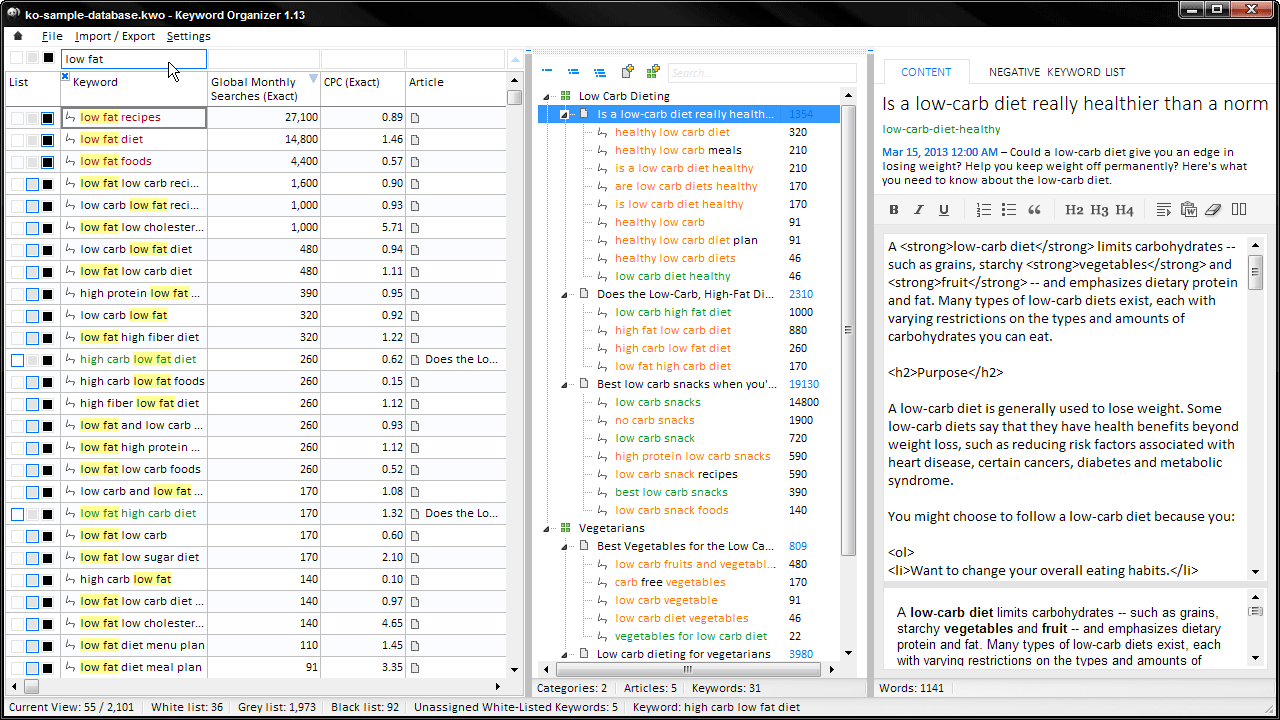
What can Keyword Organizer do for you ?
- Import CSV files through the Google Keyword Tool .
- Separate the nice keywords from your bad keywords .
- Assign your keyword to articles groups .
- Create SEO – optimized web content .
- Export your articles derectly to WordPress.
Content Strategy Basics
1. What is a Content Strategy and why is it important?
If you’ve ever used a search engine (like Google), and wondered how they are able to seemingly telepathically predict the best piece of content that answers your search query, the short form of the answer is rather simple:
They simply attempt to match the words you’ve typed into their search box, with words that appear in their vast index of websites.
That is to say, they’ve created a large list of words that exist on all of the websites on the internet. And, when you search for these words, a network of computers will run through this index and fetch the URLs of the web documents that contain these words.
This is of course an overly-simplistic summary of what’s really going on. Search engines are much more sophisticated than they used to be. And the mere existence of the word itself on the web page is only one factor in ranking.
Still, you can see why SEO (Search Engine Optimization) is taken so seriously. Because, in the least, a website that does not contain the user’s desired keyword, is less likely to rise to the surface, than a website that does contain the searcher’s word.
So when we refer to the “Creation of a Content Strategy,” this typically entails the development of keyword-optimized informational web articles. The SEO guy (sometimes pretentiously called the “content strategist”) will examine a body of keyword data and select the keywords which he feels are conducive to the marketing of the product or service that the website caters to.
A lot of time, money and effort are then attributed to content writers (content developers) who devote their efforts to creating “web resources informational articles that satisfy (or partially satisfy) the spirit of the user’s keyword query.
Such content is created for a couple reasons:
- In a product-based website business model (e.g. company selling a web app or a video course), the site owner hopes that a visitor will serendipitously stumble upon the web resource, and be so impressed by the content or persuaded by the pitch, that this user will ultimately become a paying customer.
- In a content-based website business model(e.g. a magazine or blog), the site owner hopes to use Search Engine Marketing to attract as many visitors as possible. Some percentage of these visitors will view an advertisement or (even better) click on one. The more ads clicked, the more the site owner gets paid.
2. Finding Keywords 
The first step in the creation of a content strategy is to generate a list of keywords that people are searching for on the internet. This usually means starting off your journey at the infamous Google Keyword Tool and typing various “seed keywords” into its search box.
If you’re not familiar with the Google Keyword Tool, it’s a web interface (owned by Google of course) that allows you to generate a body of keyword data which contains a wealth of important information like the “search volume” (the number of times the keyword is queried per month), and the “cost-per-click” (the approximate amount that an Adwords publisher is paying for his ad to be displayed for this keyword.
Google’s Keyword Tool examines your inputted keywords and returns thousands of related words that may be correlated with your product or service. Now you need to save these keywords somewhere. So typically you’ll proceed to download a batch of CSV files to your computer, and perhaps stitch them together and attempt to work with them in a spreadsheet app like Microsoft Excel. But working with the keywords in Excel can be a bit tedious. Keyword Organizer was created to streamline this process and make keywords easier to manage.
3. Selecting the right keywords for your website
How do you know which keywords to use? This is one of the more difficult questions in SEO. And the answer is different for every business model. Note that SEO is both an art and a science.
Generally speaking the right keyword for your website is one that is conducive to the marketing of your product or service. Ultimately, the keyword-selection task is much easier if you have a deep understanding of your target demographic”prior to ever sitting down to look at a keyword spreadsheet.
You might start off by asking yourself the following questions:
Does the product or service I sell solve this user’s problem?
Am I the answer to this person’s question?
Do I personally know how to answer this user’s question?
Can I ascertain what this user is looking for, based on the keyword phrase itself?
Can I create content for this query that will leave the user satisfied that they have completed their search successfully?
Do I have experience with people asking this question?
There is, of course, no perfect algorithmic method for deciding which keywords you will ultimately target in your web content. So if you’re just starting out in your search engine marketing efforts, you might want to just start small. Pick a couple dozen keywords and create a few articles that genuinely cater to the searcher’s needs.
4. Plan a Content Strategy and Cluster your keywords
After you’ve chosen a batch of keywords to target, it’s time to assign these keywords into distinct article groups. Typically, a few keywords will pop out at you, and you’ll notice that they are similar enough, such that they’d fit nicely together into one article.
Consider, for example, the following list of keyword phrases:
how to organize keywords
organize keywords for a website
arrange website keywords
keyword organization
keyword organizer software
Now it should be pretty obvious that such keywords should be clustered together and placed into one article. (Namely, the article you’re reading right now.) There wouldn’t be much utility in fracturing this little group into five individual articles. Rather, it’s in my interest to simply make sure I cover the “letter and the spirit” of these five keyword phrases in this homepage document.
However, the subjective and stylistic nature of content strategy planning comes into light when the keyword phrases are more ambiguous. Take for example the phrase “web content writing.” Now at first glance, it may appear that this website may satisfy the commercial intent of this searcher. Helping people write content for their website is exactly what Keyword Organizer does. But if we dig into this phrase a bit more, we’d probably find that the majority of people who type in this keyword are probably looking to either hire a web content writer, or get a job as a web content writer. A third of them are probably looking for general information regarding the content creation process. Likely very few of these searchers are actually interested in purchasing a software package that helps them write web content.
Hence, it wouldn’t be in my interest to actively pursue this keyword phrase (“web content writing”) in my on-site and off-site marketing efforts. It would be much more beneficial for me to angle my efforts to keywords that are probably more reflective of a person who is ready to buy an app. The phrase “web content writing software,” for example, is obviously a more economically viable venture.
So this is the thought process you must go through with each keyword. If you’re familiar with your target market, then this usually goes pretty quick. You should be able to glance at most keywords, and decide in a couple seconds if the keyword is (or is not) conducive to your content marketing efforts.
When this part of the content planning process is done, all of your keywords will be arranged in nice little clusters (sometimes called “Keyword Groups”), then it’s time to start thinking of some post titles.
5. Create your article titles
Every internet document is indeed just that. A document. And all documents need a title. So your next task is to create a unique title for your web document.
As you glance at any given keyword group, you’ll find that they often lend themselves to the creation of a rather obvious title. Consider this group:
low carb snack foods
best low carb snacks
no carb snacks
low carb snack recipes
Right off the bat, we can see that we’re going to be using the words “low carb snack” in our article somewhere. Now, this is the point where your copywriting skills come into play. Well need to create a title that encapsulates our target keywords, and yet also has an alluring ring to it.
This is important because search engines will rank our document (in part) based on how many clicks the title is getting–relative to other documents on Google’s Search Results Page (the “SERP”). Hence, a title that has a bit of stylistic panache, might (in theory) ultimately rank higher than a title that didn’t have anything appealing to say.
Hence, instead of just titling our document “Low Carb Snacks,” we might try something like this:
“10 Low-Carb Snacks you can make at home. A healthy way to satisfy your hunger.”
6. Write your article and use your keywords in the article content
Now that your keywords are arrayed in nice, neat little groups, and creative article titles have been assigned to each group, it’s time for the hard part. You have to actually write something.
It is very easy to let the keyword data hinder the creative writing process. So be wary of that. Keywords can be very distracting and you don’t want to allow the metrics to overtake your mind”while you’re putting pen to paper and channeling your muse.
So let the keywords and the keyword group titles merely act as the locus for your article content creation efforts. Just glance at them, and then create a web resources that you’re sure your target demographic will find useful.
And, once the writing process is nearing completion, you can then pull out your keyword group and skillfully “pepper in” the keyword phrases into your article content.
In Keyword Organizer, we’ve added a text editor. As you create your content, the keywords that have been associated with the article will change color.
The color Black means that the keyword phrase hasn’t been used in the article yet.
The color Orange means that portions of the keyword phrase are in the article.
The color Green means that the whole keyword is in the article.
Additionally, if you hold your mouse down on the keywords themselves, then the keyword’s position in your article content will highlight. So you can see how this is particularly useful when creating article content. Because Keyword Organizer is constantly watching the document as you type, and it will tell you if you’ve used your keywords in your article content or not.
So it does a pretty good job of helping you make (what is commonly referred to as) an SEO-optimized document. A document where your target keywords are nicely scattered throughout the various document fields.
What can Keyword Organizer do for you?
1. Import CSV files from the Google Keyword Tool
Using the good ol’ free Google Keyword Tool is great. It produces an un-ending supply of great keywords–from which you can create content on your website. But there’s a problem. If you’ve ever actually sat down and tired to arrange these CSV files into a viable content strategy, then it becomes clear very fast how difficult the task is.
Keyword Organizer has been specifically designed to tame Google’s CSV files for you. It gobbles up their data and displays the goods elegantly–in a clean, minimalistic interface that you’ll find very easy to use.
2. Separate the good keywords from the bad keywords
When you’ve got a few thousand keywords on your plate, then the job of determining which keywords you’re going to go far, can be a bit daunting.
Keyword Organizer has a a sophisticated assortment of sorting, searching, and categorization tools–all designed to help you weed out the keywords you don’t need, and arrange the keywords you’d like to target.
3. Assign your keywords to article groups
Ultimately, your job in the creation of on-site content, primarily comes down to assigning keywords to logical clusters. In SEO, we create content resources out of these clusters. And these resources act as the “lure” that draws in search engine visitors to our website.
Keyword Organizer allows you to type in partial article titles (or concepts) and prompt Google to “fill in the blank.
4. Create SEO-optimized web content
Once you finally know which keywords you’d like to use in your content strategy, you need to actually write your article. And, in SEO, we’ll need to “pepper in” our keywords into various locations in our article content.
Keyword Organizer examines your content while you type. And the keywords themselves will change color, based on if they do, or do not, appear in the article content.
5. Export your content directly to WordPress
Writing a batch of articles for your website is hard enough. But actually publishing the content (one-by-one) to your website can be quite a chore.
Keyword Organizer was designed to talk to the free WordPress “CSV Importer” plugin. So once your content is all done, with the press of a button, you can export all your content articles to your WordPress installation.
How can you use Keyword Organizer?
To become a member to access Keyword Organizer, you need to spend $37 for a member account. After becoming a member, you will be given a username and password to enter member area; then you will be learning how to get $1,000 online. Very simple!
Prize OF Keyword Organizer:
Maybe after looking at some great functions of Keyword Organizer, you think that it will be expensive, right? NO! It only costs $37 in price . In my opinion, this is a soft price for an awesome Software that could help you save time and make more money. I highly recommend you should get it NOW when the price at lowest. Because the price will increase after. So if you decide to use it, quickly to grab it right now!
About Author
Vendor of this product is Mark Thompson! As you know, Mark Thompson is great marketer with over 10 previous product that’s good and receive great review from people who use it!
He is a full-time Internet Marketer with over 5 years experience and the creator of StayOnSearch. As you can see, almost previous product launching is many great products to meet the market demand that range from SEO, PPC, Social Media, E-mail Marketing, and Affiliate Marketing, such as: WP4FP 2.0, Curation soft, Intelli theme, BonusPress, List Eruption 2.0…
Conclusion:
I hope my review for Keyword Organizer could help you find out new things to get success with this. But if you feel that this post still lack of information, please check out more here. And if you decide to get Keyword Organizer to increase your income, simply click here to get it now and receive my bonus worth over $4500, you could check the bonus out here. It’s yours free, but it just for quick decision maker, it’s limited time offer. So be quickly before this offer end. Your decision, YourSuccess
Click Below To Get Keyword Organizer


Get The both of Vip Bonus $4500. The Bonus only here
3 simple steps to claim this bonuses
- Get Keyword Organizer by Clicking here to download it now
- After completing the transaction, forward the receipt to my email at: [email protected]
- You will receive all the bonuses within 24 hours
- Call me: +84935852325 you’ll accept Bonus within 15′
Thanks for visit my page Keyword Organizer. Hope you could find useful information here. Wish you all the best. Cheers!
]]>