A SaaS renewal can become a contractual obligation long before the next invoice arrives. Assign an owner to the notice deadline, establish how valid cancellation notice must be sent and record the binding term, seat charges and data-exit rights. Where a material clause remains unclear, preserve the correspondence and seek written clarification or qualified review rather than guessing.
A subscription may renew while the person who signed the agreement has already left the company. Unused seats can remain on the bill, and cancellation discussions may begin after the notice deadline. The contract register exists to prevent that sequence from going unnoticed.
A good contract review answers four questions. Which agreement applies? How long is the commitment? What stops a renewal? What happens to your bill and your data if you replace the software?
Those answers often sit in different places: a signed order, online terms, amendments and subscription controls. The checks below pull them into one purchasing decision.
What to check before you sign or renew a SaaS contract
Run five checks: the governing documents, the subscription and renewal terms, the notice cutoff and delivery method, price and seat commitments, and data-exit rights with a named owner. Mark each one confirmed, unclear, or needs escalation before you proceed.
Which documents and versions govern the deal?
The renewal clause that controls your deal can sit several clicks away from the quote your sales contact sent.
Start with the signed Order or subscription form and follow its references. The stack can include a master services agreement, an online customer agreement, product-specific terms, a statement of work, support commitments, a data-processing addendum and later amendments. A reseller deal can put different parties in charge of pricing and notice than a direct purchase.
Check the order of precedence first. A phrase like “unless otherwise specified in an Order” means the signed Order overrides the published default. A later website revision is also a different thing from the version your agreement incorporates.
Read an actual renewal clause as a buyer would
The Atlassian Customer Agreement, effective October 1, 2026, puts several of these decisions in one set of provisions.
- Order-specific terms: Section 10.1(c) makes the published renewal defaults depend on your Order and on product availability, so the signed documents come first.
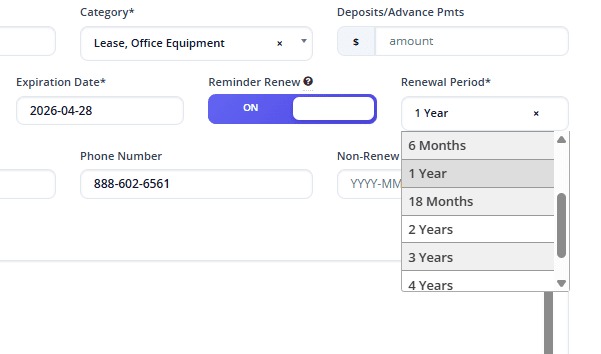
- Renewal period: Under that default, a previous term shorter than 12 months normally renews for the same shorter duration, and a term of 12 months or longer normally renews for 12 months. Those are the values you would enter in the renewal-term field of a contract record.
- Renewal rate: The same provision refers to then-current rates. Check which rate applies to your next term under your agreed documents.
- Notice route: Section 10.1(c) lists the ways to give non-renewal notice. Match those methods to your agreement and your term end.
Atlassian’s archive lists a preceding Customer Agreement covering August 17 through September 30, 2026. The October 1 agreement is a published example. Your own accepted version, Order, amendments and any product or reseller terms decide your actual deal.
A Heroku Enterprise user shows what happens when a renewal PDF arrives and nobody compares it with the existing terms:
They have sent me new quotes with new surprise terms added on, like requiring us to switch to annual billing.
Keep one versioned set of signed documents, incorporated terms, amendments and renewal quotes. Add the vendor and clause references, so you can reconstruct the agreement after the online terms change.
Annual commitment versus monthly billing
An annual subscription billed monthly can commit you to a full contract year. Invoice frequency sets the payment schedule. The subscription term sets how long the commitment runs.
Two contracts can produce identical monthly invoices and very different exit options.
| Contract feature | Monthly term, billed monthly | Annual term, billed monthly |
|---|---|---|
| Initial commitment | One month | Twelve months |
| Invoice frequency | Monthly | Monthly |
| Possible renewal | Monthly | Annual |
| Early departure | Set by the agreement | Remaining obligations can survive |
The right to end service early, and any payment consequence, sits in the actual agreement. For connected services, the contract should also reflect the required integration behavior.
One small-business customer ended up in a renewal dispute over plan wording:
We had been using a SaaS tool on our small team for about a year, on the “annual, billed monthly” plan.
The poster planned to switch software, then found a 60-day notice clause and a following 12-month renewal commitment.
Some annual plans allow early termination under set conditions. Others leave fees owing or treat credits and refunds differently. Adobe, for example, publishes plan-specific subscription terms, and those conditions don’t carry over to another vendor’s contract.
Record commitment length and invoice cadence as separate fields, along with any early-termination, remaining-payment, refund or credit provision.
Notice windows, license reductions, and exact deadlines
A subscription’s renewal date can fall well after your last chance to stop it. A license reduction can have its own deadline under the purchasing program.
Track four dates separately:
- Initial term start: When the subscription period begins.
- Term end or renewal: When the current period ends and another can begin.
- Effective non-renewal cutoff: The last moment a valid notice must take effect.
- License-change window: A program-specific period for reducing a quantity, changing an order or requesting a permitted cancellation.
A 60-day notice calculation
Imagine a SaaS agreement whose term ends June 30, 2027. Its notice clause requires non-renewal 60 calendar days before term end.
Count back 60 calendar days and you get May 1, 2027. Before you rely on that date, read how the contract treats receipt, deemed delivery, time zones, business days and any defined cutoff time.
Microsoft Partner Center has a different kind of window
For specified new-commerce license-based subscriptions managed through Partner Center, Microsoft Partner Center documentation describes a seven-day, or 168-hour, cancellation window and license-decrease conditions.
After a subscription renews, the seven-day window starts when renewal processing completes. Scheduled changes for the next term work through a separate mechanism. Partner Center’s conditions and exceptions depend on the subscription offer, channel and event, and they are not general cancellation rules for every Microsoft 365 buyer or other SaaS subscription.
A managed service provider asked for a license reduction after that window closed:
We spend hundreds of thousands yearly in licensing and even after 3 escalations from our original ticket we made just 12 hours after the 7-day window expired, they still refuse to help us reduce the license count in the slightest.
Calculate the notice cutoff from the actual term end and the agreement’s timing rules. Record the clause reference for that calculation and set an earlier internal review date that leaves time for a purchasing decision.
What counts as valid non-renewal notice?
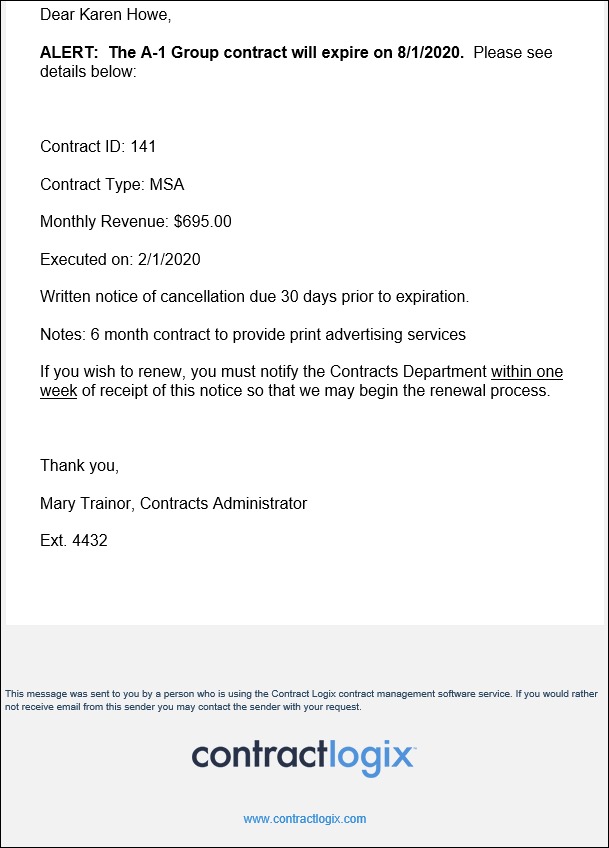
A notice counts only if it follows the contract: who sends it, who receives it, how it is delivered and when it lands. Some contracts also require an acknowledgment or treat a notice as delivered on a set day.
Agreements treat early termination, non-renewal and seat reductions differently.
| What you want | Clause or rule to examine | Decision it controls |
|---|---|---|
| Prevent the next term | Non-renewal and notice provisions | Whether another subscription period begins |
| End the current term early | Termination rights and payment consequences | Whether obligations can end before expiration |
| Reduce seats or change plan | Order minimums, amendments, and product or channel rules | When and how committed scope can change |
Choose the mechanism that matches your goal. A request to reduce seats can leave the subscription agreement intact.
What a real notice clause adds
Atlassian’s Section 10.1(c) lets customers give non-renewal notice through account settings, by contacting support, or by otherwise providing notice.
Section 20.5(a) adds a detail: email notices it covers are generally deemed given on the first business day after sending, with exceptions for formal notices such as infringement, breach, and termination for cause. Read the renewal provision and your Order together.
A message sent on the last calendar day of a term can take effect later under a deemed-notice rule.
A HubSpot Community user ran into a missing control:
The option to Turn On or Cancel Subscription Auto-Renewal is missing in some of our instances.
When the portal control is missing, you need another notice method the agreement allows.
The six-part notice evidence packet
- Agreement basis: The contract, its version and the notice provision.
- Authorized sender: The person or entity allowed to give notice.
- Recipient and channel: The party and delivery method the contract names.
- Timestamp: Send date and time, with time zone where relevant.
- Delivery or effectiveness: Receipt, acknowledgment, or the deemed-notice rule.
- Supporting record: The notice text, confirmation, ticket, screenshot or correspondence.
Send notice by an authorized method early enough for it to take effect, and keep the evidence. If the portal fails, use another method the contract allows and keep proof of the attempt.
Who owns the renewal date when staff leave?
Every renewal needs a primary contract owner and a backup. Both must be able to find the signed terms, receive notices and reach whoever approves purchases.
A billing contact, a software administrator and an authorized signatory can be three different people. If the system depends on a departing employee’s mailbox, the renewal information can disappear before the subscription changes.
A HubSpot Community customer described that kind of failure:
The renewal notices sent in December 2025 and January 2026 were filtered into my spam folder.
The same customer reported that a secondary contact had left the company and that staffing changes had left paid seats unused. The renewal is disputed, and the thread shows no final resolution.
Give the primary owner a named backup and an agreed escalation route. The backup needs access to the agreement and the next internal decision date. A departure, a disabled address or a change of reseller should trigger a handover.
A calendar reminder helps you reach the decision on time. It does not give non-renewal notice. To set one up, see the contract-renewal calendar.
Renewal term, price uplift, and seat commitments
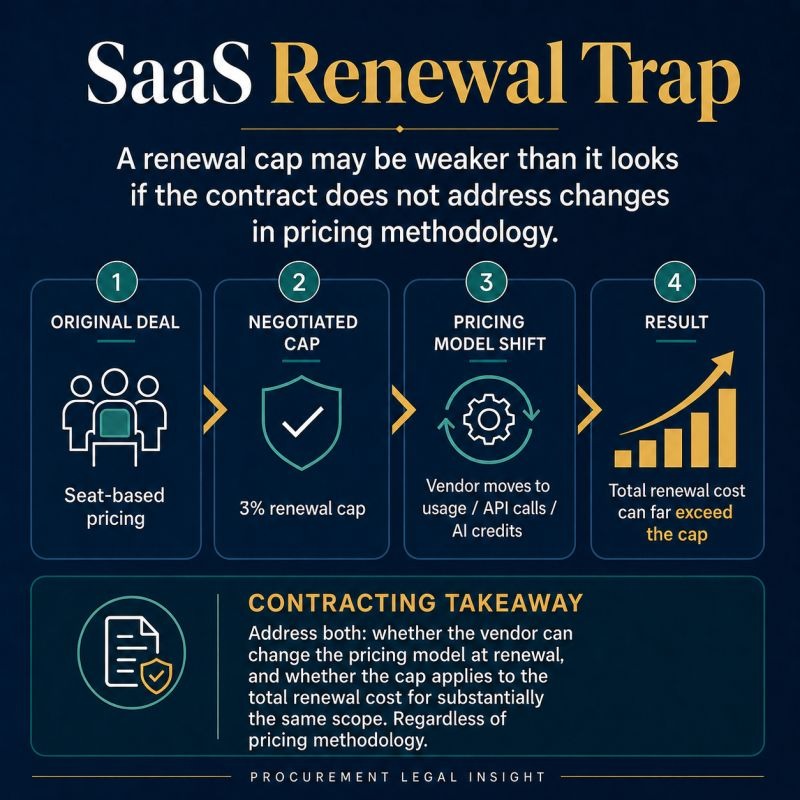
What you owe at renewal depends on the next term’s fees, committed scope and change rights. You can cut your real usage and still owe payment for the licensed capacity in your agreement.
Published vendor terms can allow rate changes at renewal. The Atlassian example uses then-current rates for renewal, subject to the Order. Its Section 10.1(d) also covers charges tied to increased Scope of Use.
Compare current and proposed terms on five lines:
| Dimension | Existing commitment | Proposed renewal |
|---|---|---|
| Term | Agreed duration | Next subscription period |
| Seats and usage | Purchased quantity and permitted scope | Revised minimum or allowance |
| Price | Current fees and add-ons | Proposed rates, uplifts, and charges |
| Amendments | Existing modification provisions | New limitations or options |
| Payment | Existing invoice schedule | Proposed billing cadence |
The key question is what you pay, and for how long, if staffing or usage changes during the renewed term.
Imagine a company that bought 20 CRM licenses and now has 12 active users. Cutting the next commitment to 12 licenses can depend on a seat minimum, an amendment provision, a product rule or a reseller agreement.
Should you accept or negotiate out auto-renewal?
Automatic renewal protects service continuity when your business relies on a tool every day. It can also lock you into another term after your needs change.
Consider an operational platform whose interruption would disrupt customer work. A predictable renewal helps there. A temporary marketing application, or a tool you plan to replace, calls for a shorter commitment and more flexibility.
Points to negotiate:
- Renewal control: Manual renewal or a shorter following term.
- Price predictability: An agreed rate mechanism or a defined limit on increases.
- Notice practicality: A clear deadline and a usable delivery channel.
- Changing demand: An express right to reduce licensed seats or committed scope.
- Exit coordination: Defined access, export, and transition provisions.
Expect pushback: A vendor may prefer predictable renewal revenue and decline requested amendments, especially on a standard self-service subscription. An offered change becomes part of your terms only when it is written into the governing agreement.
Decide your priority before you negotiate: continuity for a mission-critical service, or flexibility for a tool whose use may change. That tells you which change is worth making your purchase conditional on. For the larger purchasing process, consult the software buying guide.
What termination and data-exit rights survive cancellation?
A subscription can end before you finish retrieving records or disconnecting systems. The termination and data-exit provisions set your access and transition terms.
Agreements separate expiration after non-renewal, termination for cause, termination for convenience where permitted, and suspension for nonpayment. Fees, cure periods, and continuing obligations vary by mechanism.
Atlassian’s Section 12.2 lets a customer terminate for convenience on notice. The customer generally receives no refund and must immediately pay unpaid amounts for the current subscription term and applicable service periods, subject to Section 10.3. Section 10.3 separately sets a 30-day return policy for qualifying initial Product Orders, with stated conditions and product-specific exceptions.
Section 12.4 covers the end of product access and deletion of customer data under applicable documentation and legal requirements. Your product documentation and accepted agreement set the export and retention conditions.
If you leave a CRM, you may need customer histories, notes, attachments, invoices, and any integrations the replacement system relies on.

Confirm the permitted export method, required files, access end date, retention arrangements, transition assistance, and any fees.
When the auto-renewal deadline has already passed
After the notice deadline, work out your actual position before you ask the vendor or reseller for anything.
A procurement participant inherited a contract from a departed buyer:
The previous buyer left organization without any handover and a SaaS contract due for auto renewal in 2 days while termination notice period 60 days prior to renewal date.
The poster’s organization wanted to leave after the notice period had passed. The thread shows a late discovery. It gives no confirmed way out of the renewal.
Establish the chronology first
Reconstruct the events that matter:
- Accepted contract: Executed version and amendments.
- Critical dates: Term, notice cutoff, and renewal event.
- Communications: Messages sent or received, and who had authority to act.
- Vendor response: Written position on the renewal, charges, and available changes.
- Financial exposure: Invoices and amounts the vendor says you still owe.
Your routes can include an express termination provision, an agreed amendment, a negotiated reduction, or an exception the vendor accepts. A missed deadline does not settle enforceability by itself, because the contract, the applicable law, and each side’s conduct can change the analysis.
Ignoring an invoice or reversing a payment does not automatically end a contractual obligation.
Send a written proposal based on the chronology and the agreement. If the amount or the disagreement is large, have qualified contract counsel assess your rights and risks before you withhold payment or take a position on enforceability.
Do US click-to-cancel laws protect business SaaS buyers?
US subscription law does not give every business SaaS buyer a universal right to cancel an annual commitment online.
The history of the Federal Trade Commission’s Click-to-Cancel amendments matters here. The Eighth Circuit vacated the 2024 amended Negative Option Rule on July 8, 2025. The FTC restored the earlier rule text effective February 12, 2026. Its March 2026 advance notice of proposed rulemaking considered possible additional amendments and was not a final replacement rule.
The Federal Register negative-option rulemaking notice documents these steps.
California’s automatic-renewal law turns on who the customer is. California Business and Professions Code Section 17601 defines a consumer as an individual acquiring for personal, family, or household purposes. Section 17602 addresses automatic-renewal offers to consumers.
A business buying software for commercial operations should have the actual transaction and the legal provisions assessed before relying on consumer cancellation protections. Other federal or state laws can matter in particular situations, but the rules above give no universal escape for business SaaS purchases. When a statutory right is central to a consequential dispute, get a qualified assessment of the parties, purpose, governing law, and facts.
One-page SaaS contract record and sign-off checklist
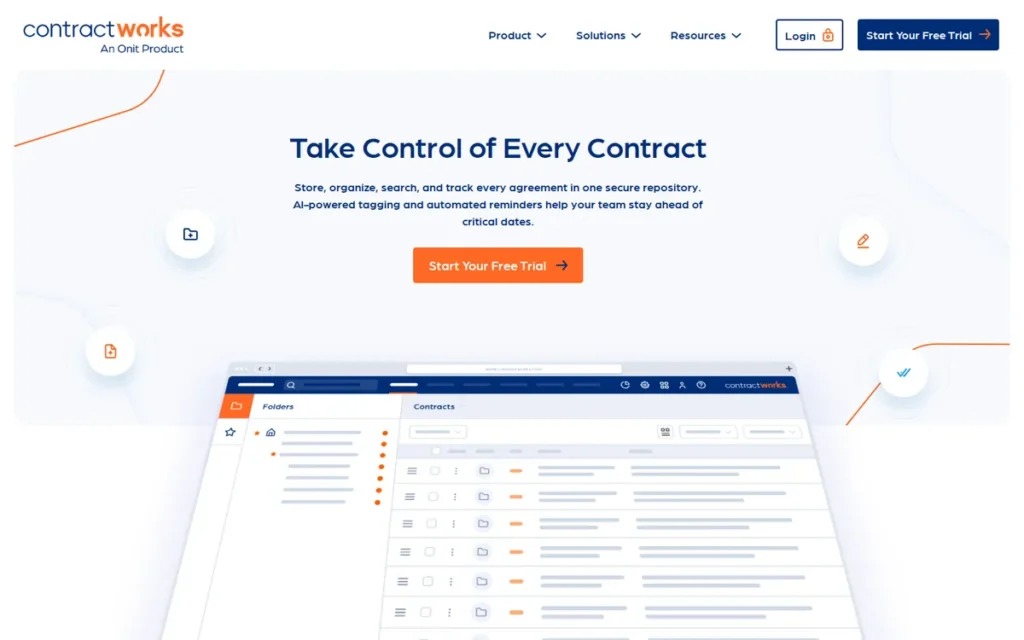
A durable contract record lets the next purchaser or administrator understand the subscription without searching a former employee’s inbox. It can live in a spreadsheet, a procurement system, or an existing internal register.
| Record group | Fields to retain | Use |
|---|---|---|
| Identity | Vendor, product, plan, buyer entity, counterparty or reseller | Identify the legal and commercial relationship |
| Documents | Executed Order, incorporated agreement versions, amendments | Recover the signed terms |
| Commitment | Term start and end, renewal length, billing cadence | Understand term and payment obligations |
| Notice | Effective cutoff, recipient, delivery channel, acknowledgment and proof | Confirm notice status |
| Commercial | Seats, minimums, rates, add-ons, permitted adjustments | Show what you owe under the agreement |
| Exit | Access, data export, retention, deletion and transition provisions | Support a future departure |
| Accountability | Primary owner, backup, internal review date, outstanding issues | Keep someone responsible |
The most useful field is the open issue that still affects the decision. A finished spreadsheet with an unknown notice method is a record of that unknown.
An illustrative contract entry
Take the CRM subscription ending June 30, 2027. Its register entry could show a May 1 notice cutoff, with the effective-notice rule and delivery method still unconfirmed. A named owner and backup would know what remains open before the company signs off.
Record the final sign-off as proceed, clarify, or escalate, with its basis and the responsible approver. The date and named approver make the decision usable at the next renewal.
Speak Your Mind